
Personalized Frozen Embryo Transfer Care at Hope Fertility & Diagnostic Center
Every fertility journey follows a different path. For individuals and couples who have embryos stored from a previous IVF cycle, frozen embryo transfer offers another opportunity to attempt pregnancy without necessarily undergoing the entire egg retrieval and fertilization process again.
At Hope Fertility & Diagnostic Center, we provide in-house frozen embryo transfer (FET) services in Kathmandu, Nepal. Our approach emphasizes individualized treatment planning, appropriate uterine preparation, careful embryo assessment, and informed patient decisions.
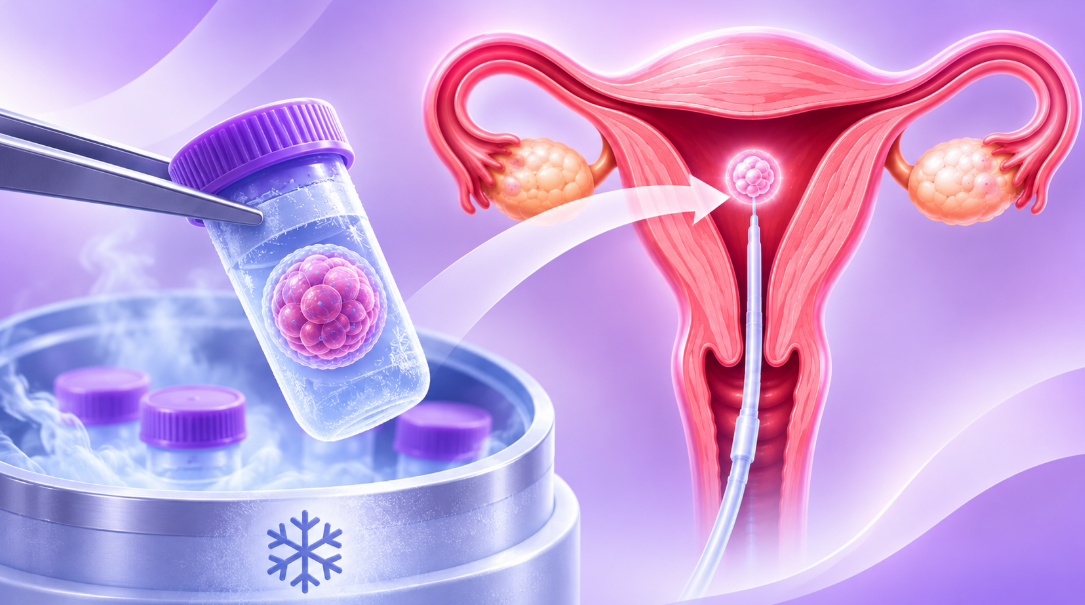
Frozen embryo transfer involves warming a previously cryopreserved embryo and placing it into the uterus when the uterine lining is appropriately prepared to support implantation.
Whether you are preparing for your first frozen embryo transfer, planning another pregnancy using stored embryos, or continuing treatment after a previous IVF cycle, our fertility team can help you understand the available options.
Book a Frozen Embryo Transfer Consultation
What Is Frozen Embryo Transfer (FET)?

Frozen embryo transfer (FET) is an assisted reproductive procedure in which an embryo created during a previous IVF or ICSI cycle is warmed and transferred into the uterus with the aim of establishing a pregnancy.
During IVF, suitable embryos that are not immediately transferred may be preserved through a process called embryo cryopreservation.
Modern fertility laboratories commonly use vitrification, a rapid cooling technique designed to minimize ice crystal formation during freezing. Embryos are subsequently maintained at extremely low temperatures in specialized cryogenic storage systems.
When a patient is ready to attempt pregnancy, the uterine lining is prepared through an appropriate treatment protocol. A selected embryo is then warmed, assessed, and transferred into the uterine cavity using a thin catheter.
Unlike a complete fresh IVF cycle, frozen embryo transfer generally does not require another egg retrieval or fertilization procedure when suitable stored embryos are available.
However, successful warming and transfer do not guarantee implantation, pregnancy, or live birth.
Learn more about how embryos are created and developed through our IVF treatment in Kathmandu, Nepal.
Potential Benefits of Frozen Embryo Transfer
Depending on individual circumstances, FET may offer several advantages:
-
An opportunity to use embryos from a previous IVF cycle.
-
No need to repeat ovarian stimulation for egg collection when suitable stored embryos are available.
-
Greater flexibility in planning the timing of embryo transfer.
-
An opportunity to recover from ovarian stimulation before attempting pregnancy.
-
A treatment option for future pregnancy using remaining embryos.
-
Reduced exposure to certain risks associated with repeating a full IVF cycle.
The suitability of FET depends on embryo availability, reproductive health, and clinical assessment.
Who May Benefit from Frozen Embryo Transfer?
Frozen embryo transfer in Nepal may be considered for patients who have suitable cryopreserved embryos available for future treatment.
Patients with Remaining Embryos from Previous IVF Treatment
After an IVF cycle, some patients have additional embryos suitable for freezing.
These embryos may be used in a subsequent treatment cycle if another pregnancy attempt is planned.
Patients Whose Fresh Embryo Transfer Was Postponed
A fertility specialist may recommend postponing a fresh embryo transfer because of hormonal conditions, concerns about the uterine lining, or other medical circumstances.
Suitable embryos may be frozen and transferred when conditions are more appropriate.
Patients at Risk of Ovarian Hyperstimulation Syndrome (OHSS)
An excessive ovarian response during IVF can increase the risk of ovarian hyperstimulation syndrome.
In selected cases, freezing suitable embryos and postponing transfer may help reduce pregnancy-related worsening of OHSS during the stimulation cycle.
Patients Planning Another Pregnancy
Individuals and couples who have previously conceived through IVF may have stored embryos available for another pregnancy attempt.
FET may allow them to continue treatment without repeating the initial egg collection process.
Patients with Unsuccessful Previous Embryo Transfer
When a previous transfer has not resulted in pregnancy, another transfer may be considered if suitable embryos remain available.
The fertility specialist may review previous treatment outcomes and recommend further assessment when clinically indicated.
Patients Awaiting Additional Medical Assessment
Some patients may need further investigation or treatment before attempting pregnancy.
Embryo cryopreservation can allow suitable embryos to be retained while these medical concerns are addressed.
Types of Frozen Embryo Transfer Cycles
Preparing the uterine lining and coordinating transfer timing are essential aspects of FET.
There are several clinical approaches to achieving this preparation.
1. Natural-Cycle Frozen Embryo Transfer
Natural-cycle FET relies on the patient's own ovulation and hormonal changes to prepare the endometrium.
This approach may be considered for patients who ovulate regularly.
The fertility specialist may use ultrasound examinations and hormone monitoring to identify ovulation and determine an appropriate transfer date.
Progesterone support may also be prescribed in some natural-cycle protocols.
Natural-cycle FET generally involves fewer hormonal medications, but its timing can be less predictable.
2. Modified Natural-Cycle FET
Modified natural-cycle frozen embryo transfer follows the patient's natural follicular development but uses prescribed medication, such as an ovulation trigger, to help coordinate the timing of ovulation.
This approach may offer greater scheduling predictability while maintaining ovulation as part of the treatment cycle.
Additional progesterone support may be recommended according to the clinical protocol.
3. Medicated Frozen Embryo Transfer
Medicated FET, also called a programmed or hormone replacement cycle, uses prescribed hormones to prepare the uterine lining.
Estrogen is commonly used to support endometrial development, followed by progesterone to prepare the endometrium for embryo implantation.
The timing of progesterone administration and embryo transfer must be coordinated carefully.
Medicated FET may be considered when ovulation is irregular, absent, or when other clinical circumstances support using a programmed cycle.
Patients must follow the medication schedule provided by their fertility specialist.
Frozen Embryo Transfer Procedure: Step by Step
The FET treatment process involves clinical preparation, laboratory embryo warming, embryo placement, and follow-up.
Step 1: Initial Consultation and Treatment Assessment
The fertility specialist reviews previous IVF treatment, embryo availability, menstrual history, medical conditions, and previous pregnancy outcomes.
Existing embryo records and storage arrangements are reviewed.
The clinical team determines whether additional investigations are necessary before proceeding.
Step 2: Selecting the Appropriate FET Protocol
Based on ovulation patterns, uterine health, treatment history, and other medical considerations, the specialist recommends a suitable endometrial preparation approach.
This may involve a natural, modified natural, or medicated cycle.
Step 3: Endometrial Preparation
The uterine lining is prepared to support potential embryo implantation.
In natural-cycle FET, this preparation depends largely on the patient's own reproductive hormones.
In medicated cycles, prescribed estrogen and progesterone are used to prepare the endometrium.
Step 4: Ultrasound and Hormone Monitoring
Transvaginal ultrasound examinations may be performed to assess endometrial thickness, appearance, and follicular development.
Hormone tests may also be recommended when clinically indicated.
Monitoring helps the fertility specialist determine whether the cycle is progressing appropriately.
Step 5: Scheduling the Embryo Transfer
The timing of embryo transfer is coordinated with ovulation or progesterone exposure, depending on the selected protocol.
The embryo's developmental stage, such as a cleavage-stage embryo or blastocyst, also influences scheduling.
Step 6: Warming the Frozen Embryo
The embryology team retrieves the selected cryopreserved embryo from storage and performs a controlled warming procedure.
The embryo is assessed for survival and suitability for transfer.
If the embryo does not survive warming or is unsuitable for transfer, the team will discuss available alternatives according to the treatment plan and patient consent.
Step 7: Transferring the Embryo into the Uterus
A suitable embryo is loaded into a thin transfer catheter.
The fertility specialist gently guides the catheter through the cervix into the uterine cavity, commonly using ultrasound assistance.
The embryo is released into the uterus.
This is generally a brief procedure and usually does not require anesthesia.
Learn more about the clinical procedure in our dedicated guide to embryo transfer in Kathmandu, Nepal.
Step 8: Post-Transfer Medication and Pregnancy Testing
Patients receive instructions about prescribed medication, follow-up care, and the appropriate date for pregnancy testing.
A blood beta-hCG test or another pregnancy test may be recommended according to the clinic's protocol.
If the result is positive, further monitoring may be arranged to assess pregnancy development.
How Are Frozen Embryos Thawed Before Transfer?
Embryo warming is a specialized laboratory procedure that prepares a cryopreserved embryo for potential transfer.
Embryos preserved through vitrification are maintained at very low temperatures until they are required for treatment.
During warming, the embryologist uses controlled laboratory conditions and specialized solutions to help the embryo recover from its preserved state.
Do All Frozen Embryos Survive Thawing?
No. Although modern cryopreservation techniques can support high embryo survival rates, not every embryo survives warming.
Some embryos may experience cellular damage or may not remain suitable for transfer.
The embryology team assesses the embryo before making further decisions.
Does Freezing Affect Embryo Quality?
Embryo quality before freezing, the cryopreservation technique, laboratory conditions, and survival after warming can influence suitability for transfer.
A frozen embryo does not continue developing while maintained under appropriate cryogenic storage conditions.
However, freezing cannot correct underlying chromosomal abnormalities or guarantee successful implantation.
For further information about cryopreservation, read the Human Fertilisation and Embryology Authority's guide to embryo freezing.
Preparing the Uterine Lining for Frozen Embryo Transfer
The endometrium, or uterine lining, plays an important role in embryo implantation.
For implantation to occur, the embryo and uterine environment must be appropriately coordinated.
Endometrial Thickness and Appearance
Ultrasound monitoring allows the fertility specialist to assess the thickness and appearance of the uterine lining.
However, endometrial thickness alone cannot predict pregnancy success.
Other clinical findings and hormonal conditions must also be considered.
Role of Estrogen in FET
Estrogen supports the development of the uterine lining.
In programmed FET cycles, prescribed estrogen may be used to encourage endometrial growth before progesterone is introduced.
Role of Progesterone in FET
Progesterone helps the endometrium undergo changes associated with readiness for implantation.
The timing and duration of progesterone exposure are important when planning the transfer of an embryo at a particular developmental stage.
Patients should never independently change, delay, or discontinue prescribed hormone medications.
The Window of Implantation
The window of implantation refers to the period during which the endometrium is receptive to an embryo.
FET protocols aim to coordinate embryo development with endometrial preparation.
No single measurement or test can guarantee implantation.
How to Prepare for Frozen Embryo Transfer
Appropriate preparation begins with following an individualized treatment plan.
Before your FET appointment:
-
Attend recommended ultrasound and laboratory appointments.
-
Follow your medication schedule precisely.
-
Inform your specialist about existing medications and medical conditions.
-
Review the planned embryo transfer date and embryo availability.
-
Follow any instructions regarding bladder preparation.
-
Discuss concerns about the procedure and follow-up care.
Patients should also avoid starting unprescribed fertility supplements, hormonal medications, or herbal treatments without discussing them with their healthcare professional.
What Should You Bring to Your FET Consultation?
If available, bring previous IVF and embryology reports, embryo freezing records, ultrasound reports, a list of current medications, and information about previous embryo transfers.
These records may help the specialist understand your treatment history.
Schedule Your FET Consultation
What Happens After Frozen Embryo Transfer?
The period after embryo transfer can involve anticipation and uncertainty while waiting for pregnancy testing.
Following appropriate aftercare instructions can help patients understand what to expect.
Continue Prescribed Medication
Estrogen, progesterone, or other prescribed medicines should be continued according to the treatment protocol.
Medication support is particularly important in programmed FET cycles.
Do not discontinue medication because of mild spotting or the absence of pregnancy symptoms.
Resume Appropriate Daily Activities
Routine prolonged bed rest after embryo transfer has not been shown to improve treatment outcomes.
Most patients can resume normal light activities according to their clinician's instructions.
Individual restrictions may be necessary when other medical conditions are present.
Understand Possible Symptoms After FET
Some patients may experience mild cramping, bloating, breast tenderness, fatigue, or light spotting.
These symptoms can be associated with prescribed hormones and do not reliably confirm implantation or pregnancy.
Having no symptoms does not necessarily mean that the treatment has failed.
When Should You Take a Pregnancy Test After FET?
Pregnancy testing is often scheduled approximately 9–14 days after embryo transfer, although timing varies according to the embryo's developmental stage and the clinic's protocol.
Testing too early can produce misleading results.
Follow the exact pregnancy-testing instructions provided by your fertility team.
When Should You Seek Medical Attention?
Seek urgent medical assessment if you experience severe abdominal pain, heavy bleeding, fainting, breathing difficulty, or significant dizziness.
These symptoms may require investigation for complications.
The American Society for Reproductive Medicine's embryo transfer guidance supports evidence-based approaches to embryo transfer and post-procedure care.
Frozen Embryo Transfer Cost in Kathmandu, Nepal
How much does frozen embryo transfer cost in Nepal?
The total cost of FET depends on the treatment protocol, medication requirements, laboratory embryo warming, monitoring appointments, and clinical procedure fees.
Because previously created embryos are used, FET generally avoids the costs associated with a new egg retrieval and fertilization cycle.
However, embryo storage, medication, and laboratory preparation may involve separate charges.
Factors Affecting Frozen Embryo Transfer Cost
| Cost component | What it may include |
|---|---|
| Fertility consultation | Medical assessment and treatment planning |
| Ultrasound monitoring | Endometrial and follicular assessment |
| Hormone testing | Clinically indicated blood investigations |
| Fertility medications | Estrogen, progesterone, ovulation triggers or other prescribed medication |
| Embryo storage | Applicable cryopreservation and storage fees |
| Embryo warming | Laboratory preparation and post-warming assessment |
| Embryo transfer | Clinical transfer procedure and related services |
| Pregnancy testing | Beta-hCG testing or other follow-up investigations |
What Should You Ask About an FET Treatment Package?
Before proceeding, clarify whether the quoted treatment price includes:
-
Initial fertility consultation and investigations.
-
Required ultrasound monitoring.
-
Hormonal medications.
-
Embryo warming and laboratory assessment.
-
Embryo transfer.
-
Pregnancy testing and follow-up.
-
Existing or ongoing embryo storage charges.
-
Fees if the cycle is postponed or cancelled.
Understanding the individual components helps patients compare treatment packages more accurately.
Contact Hope Fertility & Diagnostic Center for a personalized frozen embryo transfer cost estimate in Kathmandu based on your treatment requirements.
Request an FET Cost Consultation
Frozen Embryo Transfer Success Rates and Influencing Factors
Frozen embryo transfer can provide an opportunity to achieve pregnancy, but there is no single success rate applicable to every patient.
Several clinical and biological factors influence treatment outcomes.
Age at Egg Retrieval
When embryos are created using a patient's own eggs, the age at which those eggs were collected is an important factor affecting embryo-related prognosis.
Although current age may influence pregnancy-related health risks, the embryo's reproductive potential is closely associated with its underlying biological characteristics.
Embryo Quality and Developmental Stage
Embryo development and laboratory assessment help determine whether an embryo is suitable for transfer.
A higher embryo grade does not guarantee implantation or live birth.
Embryo Survival After Warming
An embryo must remain suitable for transfer following warming.
Its condition before cryopreservation and response to the warming procedure are relevant considerations.
Endometrial Receptivity
Uterine health and appropriately coordinated hormonal preparation contribute to the conditions required for implantation.
However, an apparently suitable endometrium does not guarantee pregnancy.
Underlying Fertility Conditions
Conditions affecting the uterus, reproductive hormones, or general health may influence treatment planning and outcomes.
Previous Treatment History
Previous IVF and embryo transfer results can provide useful information for planning a subsequent cycle.
An unsuccessful transfer does not automatically mean that all future transfers will fail.
Understanding FET Success Rate Statistics
When comparing fertility centers, distinguish between embryo survival rate, implantation rate, clinical pregnancy rate, and live-birth rate.
These outcomes measure different stages of treatment.
A laboratory's embryo survival rate should not be interpreted as the patient's probability of having a baby.
Natural vs Medicated Frozen Embryo Transfer: Which Is Better?
Both natural and medicated FET can support pregnancy when selected appropriately.
| Factor | Natural-Cycle FET | Modified Natural FET | Medicated FET |
|---|---|---|---|
| Ovulation | Occurs spontaneously | Supported by a prescribed trigger | Generally not required |
| Hormonal preparation | Mainly patient's own hormones | Natural hormones with medication support | Prescribed estrogen and progesterone |
| Suitable patients | Selected patients with regular ovulation | Selected ovulatory patients | Patients whose circumstances support a programmed cycle |
| Monitoring | Ovulation and endometrial assessment | Follicular and ovulation assessment | Endometrial and hormonal assessment |
| Scheduling | Depends on ovulation | Partially coordinated | More directly scheduled |
| Medication requirements | Usually fewer | Vary by protocol | Generally greater |
A 2026 randomized clinical study published in The BMJ found comparable healthy live-birth outcomes between natural and programmed FET in women who ovulate. The natural approach was associated with fewer maternal complications, although cancellation was more frequent.
This highlights why the choice of FET protocol should involve an individualized assessment rather than assuming one method is universally superior.
Frozen vs Fresh Embryo Transfer
Fresh embryo transfer is performed during the IVF cycle in which the embryos are created. Frozen embryo transfer takes place during a subsequent cycle using a previously cryopreserved embryo.
FET allows the timing of transfer to be separated from ovarian stimulation and egg retrieval.
However, freezing all embryos is not necessarily beneficial for every IVF patient.
The decision should consider ovarian response, embryo availability, uterine conditions, medical risks, and individual treatment goals.
Explore our embryo transfer service for a more detailed comparison of fresh and frozen transfers.
Risks and Limitations of Frozen Embryo Transfer
Although FET is an established assisted reproductive procedure, patients should understand its potential risks and limitations.
Embryo Warming Failure
Some embryos may not survive the warming process or remain suitable for transfer.
Treatment Cycle Cancellation
A transfer may need to be postponed because of unexpected ovulation, inadequate endometrial development, medical concerns, or embryo availability.
Hormonal Medication Side Effects
Estrogen and progesterone may cause symptoms such as headaches, bloating, breast tenderness, or other side effects.
Medication-related risks should be reviewed with your specialist.
Pregnancy-Related Complications
Ectopic pregnancy, miscarriage, and other pregnancy complications can occur following FET.
Certain programmed FET protocols have also been associated with a greater risk of hypertensive pregnancy complications compared with ovulatory protocols.
Multiple Pregnancy
Transferring more than one embryo can increase the risk of twins or higher-order multiple pregnancy.
Single embryo transfer may be recommended when clinically appropriate.
Unsuccessful Implantation
Even when an embryo survives warming and is transferred successfully, implantation may not occur.
FET provides an opportunity to attempt pregnancy rather than a guarantee of treatment success.
Why Choose Hope Fertility & Diagnostic Center for Frozen Embryo Transfer in Kathmandu?
Choosing a fertility center involves considering laboratory capabilities, clinical expertise, patient communication, and the suitability of available treatment options.
At Hope Fertility & Diagnostic Center, we provide in-house frozen embryo transfer as part of our assisted reproductive services.
In-House Frozen Embryo Transfer Services
Our FET services support patients seeking to continue fertility treatment using previously cryopreserved embryos.
Treatment involves coordination between clinical preparation, laboratory assessment, and embryo transfer.
Integrated IVF and Embryology Services
Hope provides IVF, ICSI, and embryo transfer services, supporting patients through different stages of assisted reproductive treatment.
Individualized Treatment Planning
Every patient has a different reproductive history and set of clinical requirements.
Treatment decisions take into consideration embryo availability, menstrual patterns, uterine health, and previous treatment outcomes.
Focus on Informed Patient Decisions
We believe patients should understand their treatment options, preparation requirements, possible risks, expected outcomes, and financial considerations before proceeding.
Compassionate Fertility Care
Fertility treatment can be emotionally demanding, particularly after previous unsuccessful attempts.
Our approach emphasizes respectful communication, patient education, and individualized support.
Accessible Fertility Services in Kathmandu
Hope Fertility & Diagnostic Center is located at Danfe, Balabhadra Marga, Kathmandu, Nepal.
Patients considering FET can arrange a consultation to discuss the available treatment pathway.
Book an Appointment at Hope Fertility
Frequently Asked Questions About Frozen Embryo Transfer
1. What is frozen embryo transfer?
Frozen embryo transfer is a fertility procedure in which a previously cryopreserved embryo is warmed and placed into the uterus to attempt pregnancy.
2. How much does frozen embryo transfer cost in Nepal?
FET costs depend on medication, monitoring, embryo warming, transfer fees, storage charges, and other clinical requirements. Contact Hope Fertility for an individualized treatment estimate.
3. How long does frozen embryo transfer treatment take?
The complete FET cycle generally takes several weeks, depending on menstrual patterns, endometrial preparation, and the selected treatment protocol. The transfer procedure itself typically takes only a few minutes.
4. Is frozen embryo transfer painful?
FET is generally performed without anesthesia. Some patients experience mild discomfort or temporary cramping during catheter or speculum placement.
5. Do I need egg retrieval again for frozen embryo transfer?
No. When suitable frozen embryos are available, another egg retrieval is generally unnecessary for the FET cycle.
6. What is the difference between natural and medicated FET?
Natural FET relies mainly on spontaneous ovulation and the patient's own hormones. Medicated FET uses prescribed hormones to prepare the uterine lining and coordinate transfer timing.
7. Is frozen embryo transfer more successful than fresh embryo transfer?
Neither approach is universally more successful. Outcomes depend on embryo characteristics, reproductive health, and the clinical reasons for choosing the transfer protocol.
8. Can frozen embryos survive for several years?
Embryos can be maintained for extended periods under appropriate cryogenic storage conditions. Storage arrangements, consent requirements, and individual embryo suitability should be discussed with the fertility center.
9. Do all frozen embryos survive thawing?
No. Although modern vitrification techniques can achieve high survival rates, some embryos do not survive warming or remain suitable for transfer.
10. Is bed rest necessary after frozen embryo transfer?
Routine prolonged bed rest is not recommended. Normal light activities are generally acceptable unless your treating specialist advises otherwise.
11. When should I take a pregnancy test after FET?
Pregnancy testing is often scheduled around 9–14 days after transfer, depending on the treatment protocol. Follow the exact testing date given by your fertility team.
12. What are the signs of successful implantation after FET?
Some patients experience mild spotting or cramping, while others have no symptoms. Symptoms alone cannot confirm implantation. Pregnancy testing is necessary.
13. Can frozen embryo transfer be repeated after an unsuccessful attempt?
Another FET cycle may be considered if suitable stored embryos remain available. Your fertility specialist may review the previous cycle before recommending further treatment.
14. Does Hope Fertility provide frozen embryo transfer in-house?
Yes. Hope Fertility & Diagnostic Center provides in-house frozen embryo transfer services in Kathmandu, Nepal, as part of its assisted reproductive treatment pathway.
Book a Frozen Embryo Transfer Consultation in Kathmandu, Nepal
Your next fertility treatment decision deserves careful planning, reliable information, and personalized medical guidance.
Whether you have embryos stored from a previous IVF cycle, are preparing for your first FET, or are exploring another pregnancy attempt, Hope Fertility & Diagnostic Center can help you understand the available treatment options.
Our in-house frozen embryo transfer services bring together clinical assessment, treatment planning, laboratory embryo preparation, and transfer care.
Take the next step in your fertility journey with a personalized consultation.
Book Your Frozen Embryo Transfer Consultation Today
Call: +977 976-7648498
Location: Danfe, Balabhadra Marga, Kathmandu 44600, Nepal.
Medical disclaimer: This content is provided for general patient education. Treatment eligibility, medications, embryo transfer protocols, risks, and expected outcomes should be discussed with a qualified fertility specialist.