
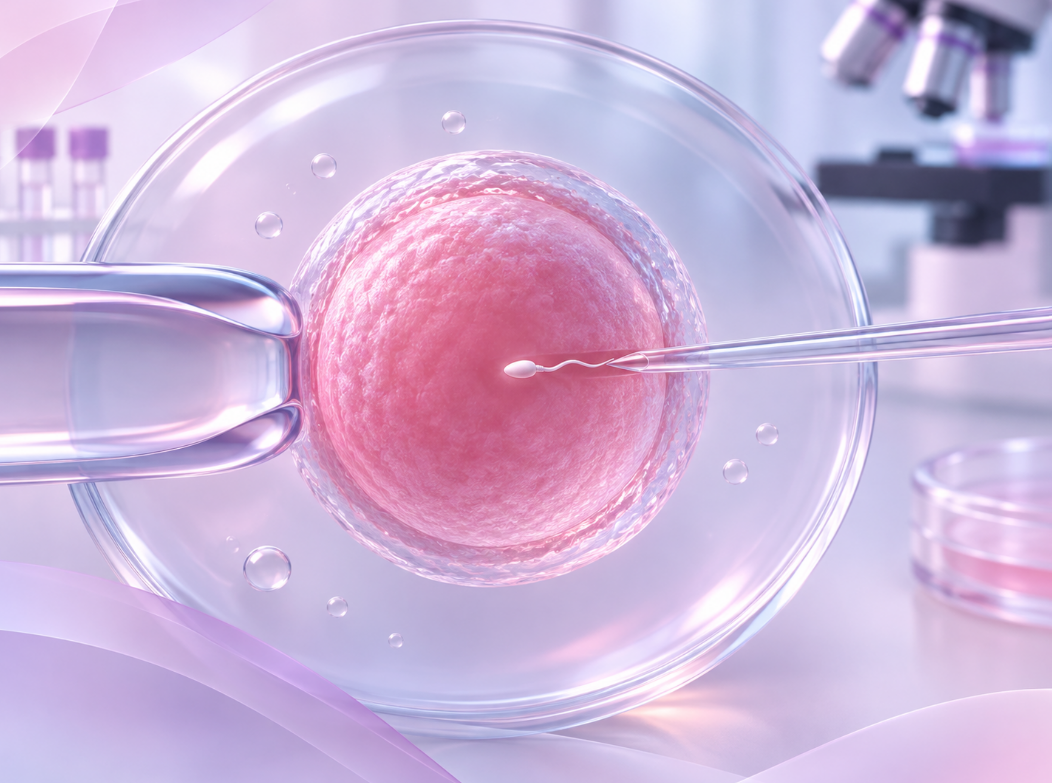
Advanced Fertility Treatment with an In-House ICSI Laboratory at Hope Fertility & Diagnostic Center
Difficulty conceiving can be especially challenging when sperm-related fertility problems or previous fertilization difficulties affect the chances of pregnancy. For some patients, a specialized laboratory technique called intracytoplasmic sperm injection (ICSI) may help overcome certain barriers to fertilization.
At Hope Fertility & Diagnostic Center, we provide ICSI treatment in Kathmandu, Nepal, using our own fertility laboratory. ICSI is performed as part of an in vitro fertilization (IVF) cycle and involves carefully injecting a single sperm directly into a mature egg.
This technique may be recommended for selected patients with significant male factor infertility, previous poor fertilization with conventional IVF, or other specific clinical indications.
Our approach focuses on appropriate fertility assessment, individualized treatment planning, clear explanations, and helping patients understand the potential benefits and limitations of assisted reproductive treatment.
Whether you are exploring ICSI for the first time or comparing IVF and ICSI, this guide explains how the procedure works, who may benefit, the tests involved, treatment costs, success factors, and possible risks.
What Is ICSI Treatment?
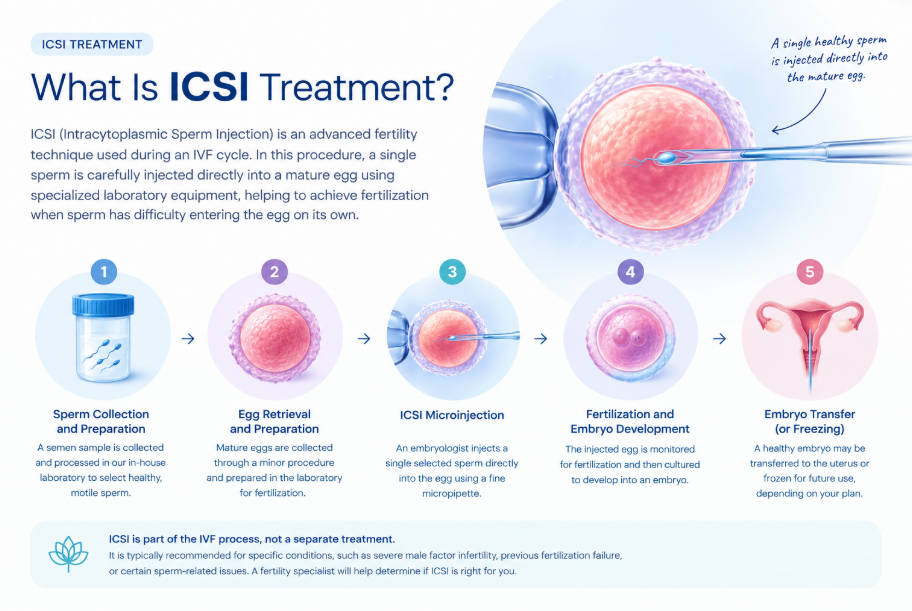
Intracytoplasmic sperm injection (ICSI) is an advanced assisted reproductive technique in which a trained embryologist injects a single sperm directly into the cytoplasm of a mature egg using specialized laboratory equipment.
ICSI is performed during an IVF treatment cycle. The patient undergoes ovarian stimulation and egg retrieval, as in conventional IVF. The main difference lies in how the egg is fertilized in the laboratory.
In conventional IVF, prepared sperm are placed alongside eggs and must penetrate the egg themselves. With ICSI, an embryologist uses a fine glass microinjection pipette to introduce a selected sperm directly into the egg.
The aim is to help fertilization occur when sperm may have difficulty penetrating an egg without assistance.
After the injection, the egg is monitored for signs of normal fertilization. If an embryo develops appropriately, it may be considered for transfer into the uterus or freezing for future use.
ICSI can assist with certain fertilization problems, but it does not guarantee that an egg will fertilize, develop into a healthy embryo, implant, or result in a live birth.
How Does ICSI Help with Fertility?
ICSI may help selected patients by:
-
Assisting fertilization when sperm have difficulty entering an egg.
-
Making it possible to attempt fertilization using a very limited number of suitable sperm.
-
Supporting IVF treatment in some cases of severe male factor infertility.
-
Providing an option after previous poor or failed fertilization with conventional IVF.
-
Allowing certain surgically retrieved sperm to be used for fertilization.
However, ICSI is not automatically more successful than conventional IVF for everyone. The technique should be selected according to the underlying fertility diagnosis and laboratory assessment.
For independent information about the procedure, see the Human Fertilisation and Embryology Authority's guide to ICSI.
Who May Benefit from ICSI Treatment?
ICSI treatment in Nepal may be considered when fertility investigations identify sperm-related problems or particular difficulties with fertilization.
A specialist should review both partners' reproductive health before recommending ICSI.
1. Severe Male Factor Infertility
Male factor infertility refers to conditions affecting sperm production, movement, structure, or delivery.
ICSI may be considered when semen analysis identifies significant abnormalities that could make fertilization through conventional IVF difficult.
Examples include severely reduced sperm concentration, poor motility, or certain combinations of sperm abnormalities.
The decision depends on the complete clinical picture rather than one semen analysis value.
2. Very Low Sperm Count (Oligozoospermia)
Oligozoospermia means the semen contains fewer sperm than expected.
In severe cases, the number of suitable sperm may be insufficient for conventional fertilization techniques.
ICSI may allow an embryologist to attempt fertilization using individual viable sperm.
Not every patient with a low sperm count requires ICSI, and the cause of the abnormal result should also be investigated.
3. Poor Sperm Motility (Asthenozoospermia)
Sperm motility refers to the ability of sperm to move.
When motility is severely reduced, sperm may have difficulty reaching or penetrating an egg.
ICSI may help overcome some of these fertilization barriers, provided suitable viable sperm are available.
4. Azoospermia and Surgically Retrieved Sperm
Azoospermia means no sperm are detected in the ejaculated semen sample.
Some patients may have sperm available within the reproductive tract or testicular tissue, depending on the cause.
In selected circumstances, procedures such as PESA, TESA, TESE, or micro-TESE may be considered to retrieve sperm.
If viable sperm are obtained, ICSI may be used to attempt fertilization.
Sperm retrieval is a separate procedure and is not suitable for every patient with azoospermia. Whether these procedures are available at Hope or require coordination with another specialist should be confirmed during consultation.
5. Previous Failed or Poor Fertilization with Conventional IVF
Some patients undergo conventional IVF but experience unexpectedly low fertilization rates or complete fertilization failure.
After reviewing the previous cycle, ICSI may be considered during a subsequent attempt to reduce the likelihood of the same problem recurring.
The cause of fertilization failure can be complex, so ICSI is not guaranteed to resolve every case.
6. Certain Other IVF Laboratory Indications
ICSI may also be considered in selected circumstances involving previously frozen eggs or particular genetic testing requirements.
However, it should not be assumed necessary simply because a patient is older, has diminished ovarian reserve, or is undergoing IVF.
According to the American Society for Reproductive Medicine's 2026 guidance, routine ICSI without a clear indication has not demonstrated improved live-birth outcomes.
When Might ICSI Not Be Necessary?
ICSI may not provide additional benefit when sperm parameters are suitable for conventional IVF and there is no history of fertilization difficulty.
A specialist may recommend conventional IVF instead, depending on the patient's circumstances.
The goal is not to choose the most technologically complex procedure, but the most appropriate treatment for the identified fertility problem.
ICSI Treatment Process: Step by Step
Understanding how ICSI works can help patients prepare for treatment and make informed decisions.
Although the laboratory injection is a specific step, the overall treatment involves a full IVF cycle.
Step 1: Initial Fertility Consultation and Assessment
The process begins with an evaluation of fertility history and previous investigations.
The specialist may review semen analysis reports, reproductive hormone results, ultrasound findings, medical conditions, previous fertility treatments, and other relevant information.
This assessment helps determine whether IVF with ICSI is medically appropriate.
Schedule a Fertility Consultation
Step 2: Ovarian Stimulation and Monitoring
During an IVF cycle, fertility medications are usually prescribed to encourage several ovarian follicles to develop.
Ultrasound examinations and, when indicated, hormone tests help monitor the ovarian response.
Medication doses and monitoring schedules depend on individual circumstances.
Step 3: Egg Retrieval
When the follicles have developed sufficiently, final maturation medication is administered according to the treatment protocol.
Egg retrieval is then performed using ultrasound guidance, generally with sedation or anesthesia.
The collected follicular fluid is examined in the laboratory to identify eggs.
Not every follicle contains an egg, and not all retrieved eggs are mature enough for ICSI.
Step 4: Sperm Collection and Preparation
A semen sample may be collected on the day of egg retrieval or managed according to the treatment plan.
The sample is processed in the laboratory to identify suitable sperm.
When sperm must be surgically retrieved, additional coordination and clinical planning are required.
The embryology team assesses sperm viability and suitability for injection.
Step 5: Assessment of Mature Eggs
Before ICSI, the embryologist prepares the retrieved eggs and assesses their maturity.
The surrounding cells are removed as part of the preparation process.
Only appropriately mature eggs are generally selected for injection.
Egg maturity and quality can affect the likelihood of normal fertilization and subsequent embryo development.
Step 6: Intracytoplasmic Sperm Injection
This is the defining step of ICSI.
Using a specialized microscope and micromanipulation equipment, an embryologist holds the mature egg in position with a fine holding pipette.
A suitable sperm is selected and introduced into the egg through a very fine injection pipette.
The procedure requires precision and specialized laboratory expertise.
The injection assists sperm entry into the egg, but normal fertilization must still occur afterward.
Step 7: Fertilization Assessment
After ICSI, injected eggs are placed in a controlled laboratory culture environment.
The embryology team checks for signs of normal fertilization, typically the following day.
Some injected eggs may not fertilize, and some may show abnormal fertilization.
The number of normally fertilized eggs varies between treatment cycles.
Step 8: Embryo Development and Culture
Successfully fertilized eggs are monitored as they develop into embryos.
Embryos may be cultured for several days, sometimes reaching the blastocyst stage around day five or six.
Not every fertilized egg develops into an embryo suitable for transfer or cryopreservation.
Embryo development depends on factors including egg quality, sperm factors, and underlying reproductive health.
Step 9: Embryo Transfer or Freezing
Depending on the treatment plan, an appropriate embryo may be transferred into the uterus during the same treatment cycle or frozen for transfer in a later cycle.
Embryo transfer is a separate clinical procedure from ICSI.
A suitable embryo is placed in the uterine cavity using a thin catheter.
The number and timing of embryos transferred should be determined through individualized clinical assessment.
Step 10: Pregnancy Testing and Follow-Up
After embryo transfer, medications and follow-up instructions are provided according to the treatment protocol.
A blood pregnancy test is generally scheduled at the appropriate interval.
If pregnancy occurs, further monitoring may be recommended.
If treatment is unsuccessful, the team can review the fertilization and embryo development results before discussing future options.
How Long Does ICSI Treatment Take?
The sperm injection itself is a laboratory procedure performed as part of the IVF cycle.
The full treatment generally takes several weeks, including ovarian stimulation, egg retrieval, laboratory fertilization, embryo culture, and follow-up.
A frozen embryo transfer may occur in a separate cycle.
The exact timeline varies between patients.
What Tests Are Needed Before ICSI Treatment?
A fertility assessment is essential before planning IVF with ICSI.
The recommended tests depend on medical history, existing results, and clinical indications.
Semen Analysis
Semen analysis is an important investigation when male factor infertility is suspected.
The assessment may include:
-
Sperm concentration.
-
Total sperm count.
-
Sperm motility.
-
Sperm morphology.
-
Semen volume and other relevant findings.
A single abnormal result does not always establish a diagnosis. Repeat testing or further investigations may be recommended.
Male Fertility Hormone Testing
When indicated, hormone tests may help investigate reduced sperm production or other male reproductive conditions.
These may include FSH, LH, testosterone, and additional hormones selected according to clinical findings.
Genetic Testing and Counseling
Certain forms of severe male infertility can be associated with genetic conditions.
A specialist may recommend genetic investigations in selected patients, particularly with severe sperm production problems or non-obstructive azoospermia.
Genetic counseling can help patients understand potential reproductive implications.
AMH and Ovarian Reserve Assessment
Anti-Müllerian hormone (AMH) testing and antral follicle count may help assess the expected ovarian response to stimulation.
These tests do not directly measure egg quality or guarantee treatment success.
Transvaginal Ultrasound
Ultrasound assessment helps evaluate the uterus, ovaries, follicles, and other relevant reproductive structures.
Additional Investigations
Other investigations may include relevant hormone testing, infectious disease screening, or uterine assessment, depending on the patient's circumstances.
ICSI vs Conventional IVF: What Is the Difference?
Patients frequently ask whether ICSI is better than conventional IVF.
Both approaches involve an IVF cycle, but the laboratory fertilization technique differs.
| Feature | Conventional IVF | IVF with ICSI |
|---|---|---|
| Egg retrieval | Required | Required |
| Sperm preparation | Required | Required |
| Fertilization method | Eggs and prepared sperm are cultured together | A single sperm is injected into each selected mature egg |
| Direct sperm injection | No | Yes |
| Main clinical use | Suitable for many IVF patients | Selected sperm-related or fertilization difficulties |
| Embryo development | Monitored after fertilization | Monitored after fertilization |
| Embryo transfer | May follow successful embryo development | May follow successful embryo development |
| Additional laboratory complexity | Generally lower | Higher |
Is ICSI More Successful Than IVF?
ICSI can be valuable when there is a specific fertilization barrier, especially in certain cases of severe male factor infertility.
However, higher fertilization rates in selected circumstances do not automatically translate into higher pregnancy or live-birth rates.
When there is no clear indication for ICSI, evidence has not shown that routinely using it improves the chance of having a baby.
Is ICSI the Same as IVF?
No. ICSI is a specific method of fertilizing eggs within an IVF cycle.
Ovarian stimulation, egg retrieval, embryo culture, and possible embryo transfer remain part of the overall IVF treatment pathway.
Learn more about IVF treatment in Kathmandu, Nepal.
How Is ICSI Different from IUI?
In IUI, prepared sperm are placed into the uterus near ovulation and fertilization occurs inside the reproductive tract.
In ICSI, an embryologist injects a sperm directly into a mature egg in the laboratory as part of IVF.
Explore IUI treatment in Kathmandu.
ICSI Treatment Cost in Kathmandu, Nepal
How much does ICSI treatment cost in Nepal?
The cost of ICSI depends on the overall IVF treatment plan, ovarian stimulation medications, laboratory procedures, sperm-related investigations, and any additional services required.
Because ICSI is performed within an IVF cycle, patients should distinguish between the ICSI laboratory charge and the total cost of IVF with ICSI.
Factors That Affect ICSI Treatment Costs
Initial fertility consultation: Medical assessment and treatment planning may be billed separately.
Fertility investigations: Semen analysis, hormone testing, ultrasound examinations, and other assessments can affect the overall expense.
Ovarian stimulation medications: Costs vary according to the prescribed medication and individual response.
Egg retrieval: This includes the procedure and related clinical services.
ICSI laboratory procedure: Specialized embryology work and equipment may represent an additional component of IVF treatment costs.
Sperm retrieval: If surgically retrieved sperm are required, this may involve separate investigations, specialist procedures, and charges.
Embryo culture and transfer: Laboratory development and the clinical embryo transfer procedure may be included or charged separately.
Embryo freezing and storage: Cryopreservation and ongoing storage may involve additional fees.
What Should an ICSI Treatment Package Include?
Before beginning treatment, ask for a written estimate that explains:
-
Whether consultations and investigations are included.
-
The expected cost of ovarian stimulation medications.
-
Whether egg retrieval and anesthesia are included.
-
Whether the ICSI laboratory charge is separate from IVF.
-
Whether embryo culture and transfer are included.
-
The cost of freezing and storing embryos.
-
Any additional sperm retrieval fees.
-
Policies for cycle cancellation or unsuccessful fertilization.
Transparent pricing helps patients plan for treatment without assuming that every IVF or ICSI package includes the same services.
Contact Hope Fertility & Diagnostic Center for a personalized IVF with ICSI cost estimate based on your fertility assessment.

ICSI Success Rates and Factors Affecting Treatment Outcomes
ICSI can make fertilization possible in selected circumstances, but treatment success depends on more than sperm injection.
The overall chance of pregnancy and live birth varies between patients and treatment cycles.
Sperm Viability and Quality
Although ICSI uses an individual sperm, the selected sperm must still be viable and capable of supporting normal fertilization.
Severe sperm abnormalities or underlying genetic conditions may influence treatment outcomes.
Egg Quality and Maturity
Egg quality is an important factor affecting fertilization and embryo development.
Age-related changes in egg quality can also influence the chance of pregnancy and live birth.
ICSI does not reverse these changes.
Cause of Infertility
The underlying infertility diagnosis influences treatment planning and expected outcomes.
Patients undergoing ICSI for severe male factor infertility may have different circumstances from those undergoing ICSI after failed conventional fertilization.
Previous Fertilization History
Previous IVF results can provide useful information about how eggs and sperm have responded to treatment.
An embryologist and fertility specialist may review earlier laboratory outcomes when deciding whether ICSI is appropriate.
Embryo Development
Successful sperm injection does not guarantee that an embryo will develop normally.
Embryos must undergo several developmental stages before they may be considered suitable for transfer or freezing.
Uterine and Reproductive Health
The chance of pregnancy also depends on factors beyond the laboratory, including uterine conditions, embryo factors, and overall reproductive health.
Understanding ICSI Success Rate Statistics
Patients should distinguish between:
Fertilization rate: The proportion of injected mature eggs that fertilize normally.
Embryo development rate: The proportion of fertilized eggs that develop to a specified stage.
Clinical pregnancy rate: The proportion of treatment cycles or transfers resulting in a clinically recognized pregnancy.
Live-birth rate: The proportion resulting in a live birth, based on the stated denominator.
These measures describe different outcomes.
A clinic's fertilization rate should not be presented as its chance of achieving a live birth.
Does ICSI Guarantee Fertilization?
No. Some eggs may not survive the injection, some may not fertilize normally, and others may stop developing.
Even when suitable embryos are available, pregnancy is not guaranteed.
A fertility specialist should discuss realistic expectations based on individual clinical findings.
Risks and Limitations of ICSI Treatment
ICSI is a well-established laboratory technique, but patients should understand the potential risks and limitations before treatment.
Possible Egg Damage
The microinjection process involves passing a very fine needle through the outer structures of a mature egg.
Some eggs may be damaged during preparation or injection and may not survive.
Failed or Abnormal Fertilization
ICSI does not guarantee normal fertilization.
Some injected eggs may fail to fertilize or may show abnormal fertilization patterns.
Embryo Development Limitations
Even after normal fertilization, embryos may stop developing or may not be suitable for transfer.
Genetic Considerations
Some causes of severe male infertility have a genetic basis.
In certain cases, relevant genetic conditions may be passed to children.
Genetic assessment or counseling may be recommended when clinically indicated.
Studies have also examined possible associations between ICSI and certain birth or developmental outcomes, but it can be difficult to distinguish the effects of the procedure from those of underlying infertility.
Patients should discuss any relevant concerns with their treating specialist.
Risks Associated with the IVF Cycle
Because ICSI is performed as part of IVF, patients may also face risks associated with ovarian stimulation, egg retrieval, and embryo transfer.
These can include ovarian hyperstimulation syndrome (OHSS), discomfort, bleeding, infection, ectopic pregnancy, miscarriage, and multiple pregnancy.
Emotional and Financial Considerations
ICSI treatment can involve significant emotional, physical, and financial commitments.
Some patients may require more than one treatment cycle, while others may not achieve pregnancy despite appropriate care.
Understanding the limitations of treatment and discussing alternative options can support informed decision-making.
For independent guidance, read the HFEA's information on ICSI treatment and safety.
Why Consider Hope Fertility & Diagnostic Center for ICSI Treatment in Kathmandu?
Choosing a fertility center involves evaluating medical expertise, laboratory capabilities, diagnostic assessment, patient communication, and the suitability of the proposed treatment.
At Hope Fertility & Diagnostic Center, we offer ICSI treatment using our own fertility laboratory in Kathmandu, Nepal.
In-House ICSI Laboratory
ICSI involves specialized laboratory procedures that must be performed with precision.
Hope's in-house laboratory supports the performance of ICSI as part of the fertility treatment process.
Patients can discuss the laboratory procedure, treatment planning, and relevant embryology services during consultation.
Individualized Fertility Assessment
Not every patient undergoing IVF requires ICSI.
We emphasize understanding the relevant fertility diagnosis before selecting a treatment approach.
Evaluation of Male Fertility Factors
Sperm-related conditions can contribute to difficulty conceiving.
An appropriate fertility evaluation helps identify whether ICSI may be beneficial or whether other investigations and treatments should be considered.
Clear Information About Treatment Options
Patients should understand how ICSI differs from conventional IVF, its possible benefits and limitations, and the financial implications of treatment.
Our approach emphasizes clear explanations and informed decision-making.
Compassionate Fertility Care
Fertility challenges can affect emotional well-being and family planning decisions.
We recognize the importance of respectful communication and supportive care throughout treatment.
Fertility Services in Kathmandu, Nepal
Hope Fertility & Diagnostic Center is located at Danfe, Balabhadra Marga, Kathmandu 44600, Nepal.
Individuals and couples considering ICSI treatment in Kathmandu can contact the clinic to arrange an initial assessment and learn more about available fertility services.
Book an Appointment at Hope Fertility
Frequently Asked Questions About ICSI Treatment in Kathmandu
1. What is ICSI treatment?
ICSI, or intracytoplasmic sperm injection, is a laboratory fertilization technique used during IVF. A trained embryologist injects a single sperm directly into a mature egg to attempt fertilization.
2. How much does ICSI treatment cost in Nepal?
ICSI treatment costs depend on the complete IVF cycle, medications, laboratory procedures, fertility tests, and additional services. Patients should request a written estimate distinguishing ICSI charges from the total IVF treatment cost.
3. Is ICSI better than conventional IVF?
ICSI may be beneficial for certain sperm-related fertilization problems or previous fertilization failure. However, routine use of ICSI has not been shown to improve live-birth outcomes for patients without a clear indication.
4. Can ICSI help with low sperm count?
Yes, ICSI may be considered for selected patients with significantly reduced sperm concentration. Its suitability depends on sperm viability, the cause of infertility, and other clinical factors.
5. Is ICSI possible with azoospermia?
Some patients with azoospermia may have sperm that can be retrieved surgically. If viable sperm are obtained, ICSI may be possible. However, not every case of azoospermia is suitable for sperm retrieval or ICSI.
6. Does ICSI guarantee pregnancy?
No. ICSI assists the fertilization process but does not guarantee normal fertilization, embryo development, implantation, pregnancy, or live birth.
7. Is ICSI treatment painful?
The sperm injection takes place in a laboratory and is not felt by the patient. However, the associated IVF cycle involves medication, monitoring, and egg retrieval, which may cause discomfort.
8. How long does ICSI treatment take?
The laboratory injection is performed during an IVF cycle. The overall treatment generally takes several weeks, although the timeline varies according to the protocol and whether embryo transfer occurs in the same or a later cycle.
9. Is ICSI necessary for every IVF patient?
No. Conventional IVF remains appropriate for many patients. ICSI should be recommended when clinical findings support its use rather than automatically for every IVF cycle.
10. What happens if ICSI fertilization fails?
The embryology and fertility teams may review egg maturity, sperm factors, and laboratory outcomes to understand possible reasons. Further treatment options depend on the findings and individual circumstances.
11. Are babies born through ICSI healthy?
Many children have been born following ICSI. Research continues into potential risks associated with assisted reproduction and underlying infertility. Patients with particular genetic concerns may benefit from specialist counseling.
12. Does Hope Fertility & Diagnostic Center provide ICSI in-house?
Yes. Hope Fertility & Diagnostic Center provides ICSI treatment using its own fertility laboratory in Kathmandu, Nepal. Patients can arrange a consultation to discuss whether IVF with ICSI is appropriate for their fertility concerns.
Book an ICSI Consultation in Kathmandu, Nepal
If you are experiencing difficulty conceiving due to sperm-related fertility concerns, have received an abnormal semen analysis result, or have experienced poor fertilization during a previous IVF cycle, an individualized consultation can help clarify your options.
At Hope Fertility & Diagnostic Center, we provide in-house ICSI treatment in Kathmandu, Nepal, as part of assisted reproductive care.
Our aim is to help patients understand their fertility diagnosis, the available procedures, expected outcomes, possible risks, and treatment costs before making decisions.
Take the next step toward understanding your fertility treatment options.
Call: +977 976-7648498
Location: Danfe, Balabhadra Marga, Kathmandu 44600, Nepal
Medical disclaimer: This content is intended for general patient education and does not replace an individualized medical assessment. ICSI eligibility, treatment recommendations, risks, and expected outcomes should be discussed with a qualified fertility specialist. All clinical descriptions should be reviewed by Hope's medical team before publication.